
Does this sound familiar? You’re sitting in a waiting room at the doctor’s office. Your child is crawling under the chairs, over your lap, and hanging upside down from the back of another chair. Your child keeps asking “How much longer??” and you’ve said, “Just another minute” for the hundredth time with no idea how much longer it really will be.
How about this one? You’re out to eat with your whole family at a restaurant. You kept your child entertained through ordering and waiting for the food. The food arrives, your child eats in 3 minutes and says, “I’m ready to go!” You’ve taken 2 bites of your food and are panicking that you’re going to have to come up with something to keep your child busy while you eat and try to catch up with your relatives. As you’re thinking of ideas, your child starts whining loudly and other people are starting to turn and look.
What about this? You’re at the park, you’ve told your child they have 5 more minutes. They acted like they heard you. You gave a 2 minute warning. Then when it was time to go, your child had the world’s biggest meltdown and begged for more time.
If any of these sounds like your family, don’t worry, you’re not alone! All 3 of these situations are about helping your child understand the passage of time, which is the skill kids need to learn patience. Patience is a hard skill for a lot of children to learn; parents ask me constantly for ways they can teach patience. And the great news is, I have the strategy you’ve been looking for! The best way to teach patience is a countdown board. Countdown boards are a fantastic way to help your child understand time and predict how long things will take, even when you don’t know exactly how long that is. Yes, such a strategy actually exists, and even better – you don’t need any fancy supplies to make it!
What are count down boards?
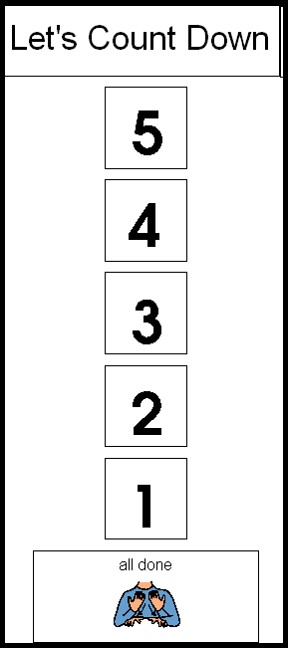
Count down boards are an amazing strategy for teaching patience to children because it helps children understand how long they have to wait to do something. On a typical countdown board, numbers from 1-5 indicate the passing of time. The board starts with all 5 numbers present (as shown in the picture on the right). As the activity progresses, the adult tells the child that it is time to check the board. The number 5 is removed and the activity continues. After another block of time, the adult prompts the child to check the board again and the next number on the board is removed. As numbers come off the board, the child sees that he or she is getting closer to the end of the time period.
Keep in mind, it is hard for children to be patient if they can’t see that they’re getting closer to what they want. The passage of time is abstract and many children struggle to understand it. A countdown board makes visible the passing of time, which allows the child to see that he or she is getting closer to the next activity. When they can see that it’s coming, and how close they are to it, it is significantly easier for children to be patient! To teach patience, you have to teach children to understand that time is passing. Countdown boards are a fantastic way to help them see that happening.
Each number on a countdown board can represent a single task (much like on a visual schedule – learn more about visual schedules here), or can represent a chunk of time. Let’s take the examples at the start of this post and see how a countdown board would work.
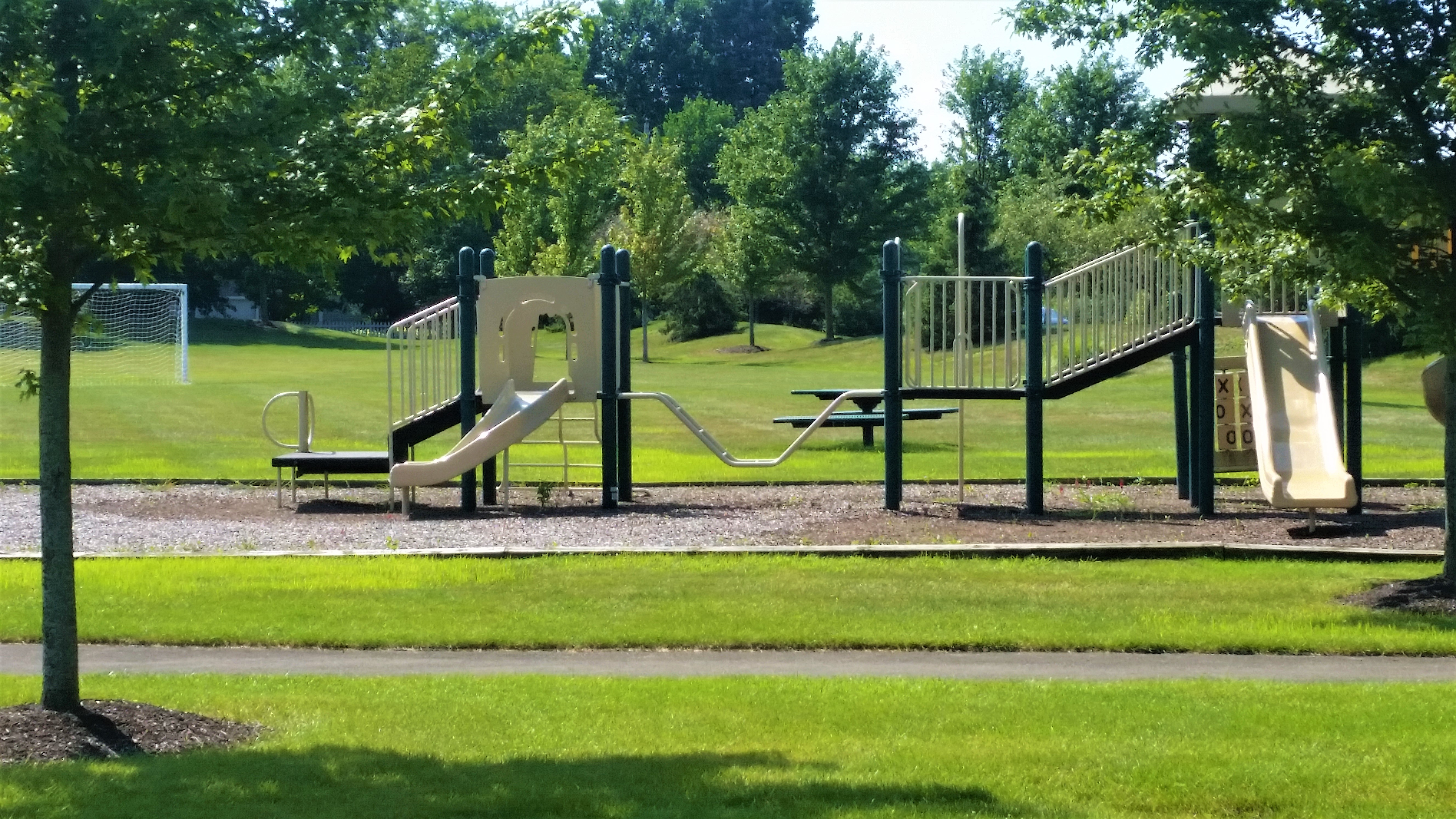
When you get to the park, you may think to yourself you plan to stay about an hour. After the first 12 minutes, you would prompt your child to check the countdown, remove a number, and return to playing. After 12 or so more minutes, you would prompt your child to check the board again. You would keep going in this fashion until all the numbers were removed and it was time to leave. But what if you suddenly see storm clouds rolling in? With a countdown board, you can modify how long each time block is. Once you see the clouds, you can have the child come check the board. After 2 more minutes, you can prompt him or her to check again. By shortening the time blocks, you can end the park time sooner than originally planned, but still provide your child with the predictability of the countdown board. You might also get to the park, run into friends, and decide you want to stay longer than originally planned. In that case, stretch out your time blocks. Call your child over to check the countdown after 20 minutes or so, rather than 12.
Countdown boards provide more flexibility than setting a timer would, but still allow you to structure activities to prevent tantrums or meltdowns. By helping your child see how much time they have left in a clear, visual way, you’re helping them understand that time is passing, which is the first step to teaching patience.
What about at the doctor’s office or restaurant? At the park, you were in charge of deciding how long to stay, but that’s not the case in the other settings. You have no idea how long you’ll wait in a waiting room. You can’t be sure how long it will take everyone to finish eating. Does it still work to use a countdown board in those settings?
Absolutely! The trick with situations that are harder to predict, time-wise, is to use your best estimate and give yourself a little wiggle room.
At the doctor’s office waiting room, you may have a sense that you’ll wait about 10-20 minutes based on how long you’ve waited in the past. It’s possible, though, you could wait 30 minutes, or more. You’ll start by showing your child the countdown board and divide the 5 segments into average time estimates. Since you think it could be 10-20 minutes, make each block about 3 minutes. After the first 3 minutes, have the child check the countdown. By the second time you check the countdown, you may be getting a sense of how long it will take today. If there were 10 families in front of you, and only 2 have been seen, you know you’re in for a long wait. Start stretching out the countdown periods to 5 minutes. If there were 10 families and there’s only 1 left, start speeding up the check-ins. When you’re down to the last number, keep it on there. Once the nurse calls your name, that’s when you can take off the final number and transition to the exam room.
At the restaurant, use the countdown board the same way. When everyone gets their meal, pull out the countdown board. Take a guess how long it takes people to eat, chat, and pay. Maybe 30 minutes for your family? Have your child check the countdown board every 6 minutes or so. After 1 or 2 check points, re-assess the time. Are people already finished and asking for the check? If so, speed up your time blocks. Are people thinking about ordering coffee and staying awhile? If so, slow down your check points. Remember, the great thing about countdown boards is they give you flexibility while still structuring the activity. You can adjust the time blocks however you need to in order to get through the task.
What if I don’t have a countdown board?
Sometimes you’ll find yourself in a situation when you don’t have any visual supports with you and you realize you need a countdown board. That’s when you need to create an “On the Go” Countdown system. The idea is to quickly find a way to help your child see the passage of time and be able to predict about how much longer he or she will need to continue the current activity. Below are some quick ideas for On The Go Countdowns. In most situations, it works to set out 5 items in front of the child and use each item just like the numbers on the countdown boards. Every few minutes, prompt the child to check the countdown and move one item to a different location (e.g., a different table, a different part of the same table, a nearby chair, etc.). When the items are all gone, the time period should be ending.
- At a restaurant. If your child is struggling to wait for his meal or wondering how much longer she has to listen to the adults talk, make an On the Go Countdown. You can use spoons, napkins, sugar packets, or crayons from the host stand. Place 5 on the table and every few minutes, take one off the table and set it back in the plastic sugar packet holder, in your purse, or on the seat next to you.
- Sitting in a waiting room. If the doctor is taking a long time, you may need to help your child track the wait. You can make an On the Go Countdown using waiting room books or blocks, magazines, business cards, or even chairs. For chairs, start 5 seats away from the door, after a few minutes, move over 1 seat so you’re 4 seats away, then 3 seats, etc. This approach works best when the waiting room has a lot of seats and not too many people!
- Stuck in the car during a traffic jam. Traffic jams can last such an unpredictable amount of time, it can be hard to know how to space out the objects. I encourage families to use their phone GPS (if possible, and if it can be done safely by another adult so the driver isn’t distracted!) to try to get an estimate before starting. The second adult (the non-driver) should manage the On the Go Countdown so the driver isn’t distracted at any time! Consider using coins from your car, napkins in your glove box, or CD cases to help track the time.
- Sitting in a performance or religious service. When your child is itching to leave, but you want to stay for the activity, try to use an On the Go Countdown. Use prayer books, pens from your purse, scraps of paper, or coins from your wallet.
Hopefully these situations will help get you thinking of creative ways to have a Count Down System anywhere you go. Obviously you will be in situations I didn’t list above, but use the suggestions above as a starting point to help you think of your own ideas for how you can help your child handle waiting!
 thebehaviorbuzz.home.blog